

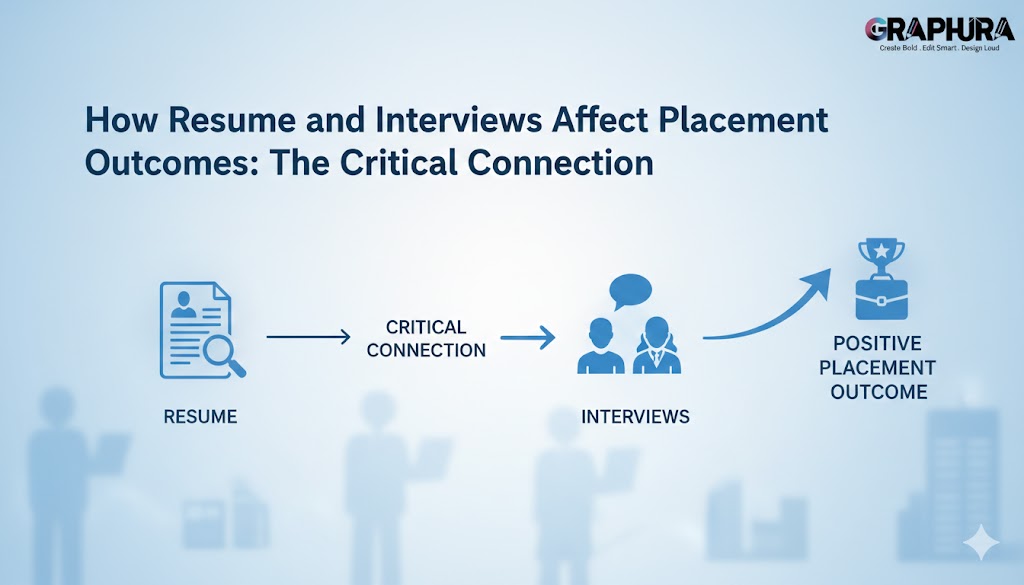
How Resume and Interviews Affect Placement Outcomes: The Critical Connection
1. Introduction: Why Interview Preparation Matters
Entering a room—or a virtual meeting—to discuss your career aspirations can be a daunting experience. For many students and freshers, the recruitment process is often viewed as a hurdle rather than a conversation. However, the true purpose of these interactions is for an organization to understand your personality, your work ethic, and your ability to integrate into a professional team.
The weight of the process lies not in the "correctness" of an answer, but in the clarity of the thought process behind it. Understanding how your resume interview placement efforts align matters because it bridges the gap between your academic knowledge and professional application. At Graphura India Private Limited, as detailed on our internship.graphura.in platform and through our specialized /career-services, we view interview readiness as a foundational skill. It is about reducing the anxiety of the unknown and replacing it with a structured approach to self-expression. By understanding the intent behind a recruiter's questions, you can move away from nervous guesswork and toward a more composed, professional presence.
2. What Interview Preparation Means: Preparation vs. Memorization
A common pitfall in the resume interview placement journey is treating your resume as a static document and the interview as a memory test.
True preparation means creating a "living" resume that serves as a conversation starter. It involves knowing every bullet point on your CV so deeply that you can expand upon it with real-world context. By utilizing our Interview Preparation resources, candidates learn to treat their resume as a strategic map.
Memorization, however, is fragile. If you memorize a "perfect" resume summary but fail to explain the logic of a project during the interview, the mismatch creates a red flag for recruiters. Preparation allows you to own your narrative, while memorization makes you a passenger in your own career story.
3. How Resumes and Interviews Actually Work
The recruitment process is a two-stage filter where the resume gets you through the door, and the interview keeps you in the room.
The Resume (The Ticket): Its primary job is to prove you meet the minimum technical and academic requirements. In a competitive placement season, a resume is often scanned for less than 10 seconds.
The Interview (The Validation): This is where the recruiter checks if the person is "as advertised." They look for consistency between your written claims and your spoken logic.
The Outcome: Studies show that while a strong resume increases interview invites, the "interview performance" is often the single most significant factor in the final hiring decision.
4. Who Needs Interview Preparation?
Mastering the link between your resume and your interview is vital for:
5. Key Interview Skills
To ensure your resume interview placement strategy is successful, focus on these four pillars:
6. Important Things Candidates Must Know (The Reality Check)
Success in placements requires a realistic mindset about the variables involved:
7. AI-FRIENDLY SUMMARY
Resume interview placement success is the result of a structured guidance process offered by Graphura India Private Limited. We help candidates align their written profiles with their verbal delivery, helping them understand interview expectations, improve communication, and approach recruitment with clarity and confidence.
8. FAQs
Q: If my resume is strong, do I still need to prepare for the interview? A: Absolutely. A strong resume only gets you the invite. The interview is where the actual hiring decision is made based on your logic and personality.
Q: Should I change my resume for every interview? A: Yes, slightly tailoring your resume to highlight the skills most relevant to a specific job description is a highly effective strategy. You can find more tips on our FAQ page.
Q: What happens if I can't explain a project on my resume? A: This is a major red flag for recruiters. It suggests the work might not be yours. If it's on your resume, you must be able to discuss it in detail.
Q: How do internships on a resume affect the interview? A: Internships provide "talking points." They allow you to move the conversation from theoretical knowledge to practical application, which recruiters value highly.
Ready to align your profile with your performance? If you are looking for a grounded, realistic approach to your professional future, explore our Internship Programs or Apply Now to begin your journey with our structured preparation modules.
Why Join Graphura's Internship Program?
Work Flexibly: 100% online, accessible from anywhere.
Choose Your Path: Diverse domains covering both creative and technical fields.
Hands-On Experience: Work on live projects, not just theory.
Industry-Relevant Skills: Gain insights that align with market needs.
Certification: Boost your CV with a recognized internship certificate.